Hotline: +8618266696519
In industrial production, building ventilation, and firefighting engineering, fans are indispensable core equipment. However, fan selection has become a major challenge for many engineers. Choosing an oversized fan can lead to excessive power consumption and high noise levels, while choosing an undersized fan may result in insufficient airflow and failure to meet design requirements. In some cases, confusion between axial fans, centrifugal fans, and firefighting fans can even cause costly rework and project delays.
In fact, fan selection is not as complicated as it seems. By understanding the core principles and avoiding common mistakes, engineers can make the right choice from the beginning and significantly reduce unnecessary costs and troubleshooting. Today, we will clearly explain axial fans, centrifugal fans, and firefighting fans from four key perspectives: working principles, application scenarios, technical parameters, and common selection mistakes — providing a practical reference that engineers can directly apply in real projects.
1. Understand the Core Principles First: How the Three Types of Fans Work
The primary function of a fan is to transport air (or other gases). The differences in operating principles between various fan types directly determine their suitable applications. There is no need to memorize complicated formulas — once you understand the “airflow direction” and “pressure characteristics,” you can quickly distinguish between them.
1. Axial Fan: “Blowing Along the Axis” — Large Airflow, Low Pressure
The blades of an axial fan are parallel to the fan shaft. During operation, the rotating blades push air in a direction parallel to the shaft — essentially “blowing along the axis.” Its key characteristic is extremely large airflow but relatively low air pressure, making it suitable for applications that require massive air exchange without significant airflow resistance.
A simple comparison is a household electric fan. As the blades rotate, air is blown in the same direction as the fan shaft, quickly circulating large volumes of air over a wide area. However, the airflow cannot travel very far or overcome heavy resistance — this perfectly reflects the core characteristics of an axial fan.
2. Centrifugal Fan: “Throwing the Air Outward” — High Pressure, Stable Airflow
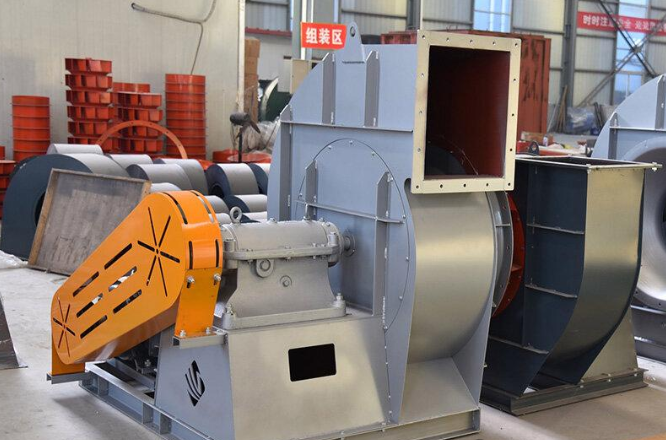
The blades of a centrifugal fan are positioned perpendicular to the main shaft. During operation, the rotating blades generate centrifugal force, drawing air into the fan inlet and then throwing it outward toward the outlet — essentially “throwing the air outward.”
Its core advantage is high air pressure, enabling it to overcome duct resistance and transport air over long distances. In addition, the airflow remains relatively stable, making it ideal for applications requiring pressurized ventilation and long-distance air delivery.
A simple comparison is a water pump. A pump uses centrifugal force to pressurize water and transport it over distance, while a centrifugal fan pressurizes air, allowing it to move smoothly through long duct systems, filters, heat exchangers, and other equipment without a significant drop in airflow caused by resistance.
3. Firefighting Fan: “A Special Mission” — Smoke Control, Exhaust, and High-Temperature Resistance
A firefighting fan is not an independent fan category, but rather a specialized fan designed for fire protection purposes. It can be either axial-flow or centrifugal in structure. Its primary mission during a fire is smoke prevention and smoke extraction, ensuring safe evacuation and supporting firefighting operations.
Its core requirements include high-temperature resistance — typically continuous operation at 280°C for more than 30 minutes — as well as reliable smoke sealing performance and compliant airflow and pressure specifications. Firefighting fans must strictly comply with fire safety regulations and cannot be replaced with ordinary ventilation fans.
Important Reminder:
Firefighting fans are classified as special-purpose safety equipment. Their selection, installation, and inspection are all governed by strict fire protection standards. Incorrect selection may not only fail project acceptance inspections but could also create serious safety hazards.
2. Accurate Matching: Application Scenarios for the Three Types of Fans
The core of fan selection is “application matching.” Different environments have different requirements for airflow volume, air pressure, and operating conditions, which directly determine the appropriate fan type. Below are the most common engineering scenarios — simply match the application to the correct fan type to avoid costly mistakes.
1. Axial Fans: Best for “Large Area, Low Resistance” Ventilation
Core application scenarios
(Where long-distance air delivery and high duct resistance are not required)
- Natural or mechanical ventilation for factories, workshops, and warehouses, where rapid air exchange is needed without pressurized airflow.
- Standard exhaust systems in office buildings and residential buildings, such as bathroom and kitchen exhaust, where ductwork is short and airflow resistance is low.
- Temporary outdoor ventilation and cooling applications, including construction sites and open-air spaces.
Additional Notes:
Axial fans are easy to install, compact in size, and cost-effective. However, they generally produce higher noise levels and are not ideal for applications requiring quiet operation or long-distance air delivery.
2. Centrifugal Fans: Best for “Long-Distance, High-Resistance” Air Supply and Exhaust
Core application scenarios
(Where airflow must overcome duct resistance or travel long distances)
- Central air-conditioning systems in shopping malls, hotels, and office buildings, where duct systems are long and contain multiple branches requiring high-pressure air delivery.
- Industrial exhaust gas treatment systems, where contaminated air must be transported over long distances through filters, ducts, and pipe bends to treatment equipment.
- Ventilation systems for cleanrooms and laboratories, where stable airflow and pressure are essential for maintaining indoor cleanliness standards.
Additional Notes:
Centrifugal fans generally offer lower noise levels and more stable airflow performance. However, they are larger in size, more complex to install, and relatively more expensive, making them better suited for projects with high ventilation performance requirements and significant duct resistance.
3. Firefighting Fans: Designed for Smoke Control and Exhaust During Fires
Core application scenarios
(Strictly designed in accordance with fire protection standards, including smoke control fans and smoke exhaust fans)
- Smoke control fans: Used for pressurized air supply in stairwells and fire protection lobbies to prevent smoke from entering evacuation routes and ensure safe occupant evacuation.
- Smoke exhaust fans: Used in basements, workshops, shopping malls, and other large spaces to rapidly remove smoke generated during fires, minimizing hazards to personnel and equipment.
Additional Notes:
Firefighting fans must be certified as “fire protection dedicated” equipment with clearly specified high-temperature resistance ratings. They must also be used together with fire dampers and smoke exhaust valves. Installation locations and airflow calculations must fully comply with the Code for Fire Protection Design of Buildings. Ordinary axial or centrifugal fans cannot be used as substitutes for firefighting fans.
3. Key Parameters: The 4 Core Indicators You Must Check When Selecting a Fan
Many engineers focus only on airflow volume when selecting a fan while ignoring other critical parameters, which often leads to poor performance or incorrect equipment selection. In reality, mastering four key parameters is enough to accurately match project requirements and avoid problems such as excessive energy consumption or insufficient ventilation performance.
1. Airflow Volume (Q): The Core Indicator Determining Ventilation Capacity
Airflow volume refers to the amount of air delivered by the fan per unit time (unit: m³/h). It should be calculated based on the required air change rate and the space volume of the application rather than selecting a fan blindly.
Example:
For a workshop with an area of 1,000㎡ and a ceiling height of 3m, requiring 10 air changes per hour:
Space volume = 1,000 × 3 = 3,000m³
Required airflow volume:
Q=1000×3×10=30000m3/h
In this case, a fan with an airflow slightly above 30,000 m³/h is recommended, typically allowing an additional 10%–15% safety margin to compensate for duct resistance and airflow loss.
2. Air Pressure (P): The Key Indicator Determining Air Delivery Capability
Air pressure represents the fan’s ability to overcome duct resistance and equipment resistance (unit: Pa). If the pressure is insufficient, air cannot be effectively delivered to the required location, even if the airflow volume meets the design target.
Key Reminder:
The longer the ductwork, the more bends, and the denser the filters, the higher the required air pressure. Centrifugal fans provide significantly higher pressure than axial fans and are therefore preferred for long-distance air supply or high-resistance systems.
3. Power Consumption (N): Determines Energy Usage
Power consumption refers to the electrical energy required during fan operation (unit: kW). Oversized power selection results in unnecessary electricity consumption, while undersized power may overload and damage the motor.
The required power should always be calculated based on airflow volume and pressure requirements to avoid situations where the fan is either excessively oversized or insufficient for the application.
4. Noise Level (dB): Impacts User Comfort
Noise generated during fan operation directly affects working and living environments and may even violate environmental regulations if excessive.
Axial fans typically produce higher noise levels than centrifugal fans. For indoor spaces or densely occupied environments, low-noise centrifugal fans or additional silencers are generally recommended.
5. Airflow and Pressure Calculation Examples for Three Common Engineering Scenarios
The following examples are based on real engineering applications and clearly explain the calculation process, formulas, and fan selection recommendations. Engineers can directly substitute their own project data without complicated calculations.
Example 1: Axial Fan for Workshop Ventilation (Low-Resistance Application)
Scenario:
A mechanical workshop with an area of 800㎡, ceiling height of 4m, requiring 8 air changes per hour. Duct length is 15m with 2 bends and no filters or heat exchangers.
1. Airflow Volume Calculation
Core formula:
Q=Space Volume×Air Changes×Safety Factor
Space volume:
V=800×4=3200m3
Required airflow:
Q=3200×8×1.1=28160m3/h
Recommended selection: axial fan with airflow between 28,000–30,000 m³/h.
2. Air Pressure Calculation
Pipe resistance:
P1=(108)×15=12Pa
Local resistance from bends:
P2=2×10=20Pa
Total required pressure:
P=12+20=32Pa
Recommended selection: axial fan with pressure ≥35 Pa.
Example 2: Centrifugal Fan for Shopping Mall HVAC System (High-Resistance Application)
Scenario:
A shopping mall central air-conditioning system serving a 5,000m³ area, requiring 6 air changes per hour. Duct length is 80m with 6 bends and 2 filters.
1. Airflow Volume Calculation
Q=5000×6×1.15=34500m3/h
Recommended selection: centrifugal fan with airflow between 34,000–36,000 m³/h.
2. Air Pressure Calculation
Duct resistance:
P1=(106)×80=48Pa
Local resistance:
P2=6×12+2×50=172Pa
Total required pressure:
P=48+172=220Pa
Recommended selection: centrifugal fan with pressure ≥264 Pa (including a 20% safety margin).
Example 3: Firefighting Smoke Exhaust Fan for Basement Applications
Scenario:
A basement area of 1,200㎡ with a ceiling height of 3.5m classified as a medium-hazard area. The smoke exhaust duct length is 40m with 4 bends and one fire damper.
1. Smoke Exhaust Airflow Calculation
According to fire protection standards:
Q=A×v×3600
Using an exhaust velocity of 8m/s:
Q=1200×8×3600÷1000=34560m3/h
Recommended selection: firefighting smoke exhaust fan with airflow ≥34,560 m³/h.
2. Air Pressure Calculation
Duct resistance:
P1=(1010)×40=40Pa
Local resistance:
P2=4×15+30=90Pa
Total required pressure:
P=40+90=130Pa
Recommended selection: firefighting smoke exhaust fan with pressure ≥156 Pa and certified high-temperature resistance of at least 280°C.
4. Common Pitfalls: The 5 Most Frequent Fan Selection Mistakes Engineers Make
Many fan selection failures are not caused by a lack of technical knowledge, but by falling into common misconceptions. The following five mistakes are among the most frequent issues encountered in real engineering projects and should be carefully avoided.
Mistake 1: Bigger Airflow Always Means Better Ventilation
Incorrect assumption:
Many people believe that the larger the airflow volume, the better the ventilation effect, leading them to blindly select oversized fans.
Consequences:
Excessive airflow can significantly increase power consumption and noise levels, and may even result in over-ventilation, such as sudden indoor temperature drops and unnecessary energy waste.
Correct approach:
Calculate the required airflow accurately according to the ventilation demand of the application and reserve only a 10%–15% safety margin. Oversizing is unnecessary.
Mistake 2: Axial Fans and Centrifugal Fans Are Interchangeable
Incorrect assumption:
Some believe that since both axial and centrifugal fans move air, either type can be used interchangeably.
Consequences:
Using an axial fan for long-distance air delivery can result in severe airflow loss and failure to meet performance requirements. Conversely, using a centrifugal fan for low-resistance ventilation may lead to unnecessary costs and excessive noise.
Correct approach:
Focus on airflow resistance and transmission distance:
- Low resistance and short-distance ventilation → choose axial fans
- High resistance and long-distance air delivery → choose centrifugal fans
Mistake 3: Replacing Firefighting Fans with Ordinary Fans
Incorrect assumption:
Some assume that ordinary axial or centrifugal fans can be used for smoke exhaust as long as the airflow volume meets the requirement.
Consequences:
During a fire, ordinary fans cannot withstand high temperatures and may fail rapidly, preventing smoke extraction and creating severe safety hazards. Such systems will also fail fire protection inspections.
Correct approach:
For fire protection applications, always use certified firefighting fans. Verify high-temperature resistance test reports and fire protection certifications to ensure compliance with regulations.
Mistake 4: Ignoring Duct Resistance and Looking Only at Airflow
Incorrect assumption:
Some engineers calculate only the required airflow while ignoring duct length, bends, filters, and other resistance factors.
Consequences:
Insufficient fan pressure prevents air from reaching the intended location, causing the actual airflow to fall far below the design target and resulting in poor ventilation performance.
Correct approach:
Always calculate the total duct resistance first, then select a fan with air pressure 10%–20% higher than the calculated resistance to ensure sufficient airflow delivery.
Mistake 5: Focusing Only on Purchase Price While Ignoring Long-Term Maintenance Costs
Incorrect assumption:
Some buyers prioritize the lowest-priced fan, believing it reduces project costs.
Consequences:
Low-cost fans are often built with inferior materials and lower efficiency, producing higher noise levels, increased energy consumption, and more frequent failures. Over time, maintenance and operating costs can far exceed the initial savings.
Correct approach:
Evaluate fan selection comprehensively by considering equipment price, energy consumption, service life, and maintenance requirements. Choosing a high cost-performance solution is far more economical in the long run.
5. Conclusion: A Simple Fan Selection Formula to Remember
- Low resistance and short distance → choose axial fans: large airflow, lower cost, but higher noise.
- High resistance and long distance → choose centrifugal fans: stable pressure, lower noise, but higher cost.
- For firefighting applications, never choose casually: always use certified high-temperature-resistant firefighting fans.
- Calculate airflow and pressure accurately to avoid common mistakes and achieve the right selection from the start.
The core principle of fan selection is “matching the application” — matching the operating scenario, technical parameters, and industry standards. By understanding the four key dimensions covered in this article — working principles, application scenarios, technical parameters, and common mistakes — engineers can confidently select the right fan, avoid problems such as excessive energy consumption, high noise, and poor ventilation performance, and achieve efficient project implementation in a single step.